
The Apothecary Before the Pharmacy
What an apothecary actually was—and the time when medicine, beauty, food, and the household still shared the same shelf.
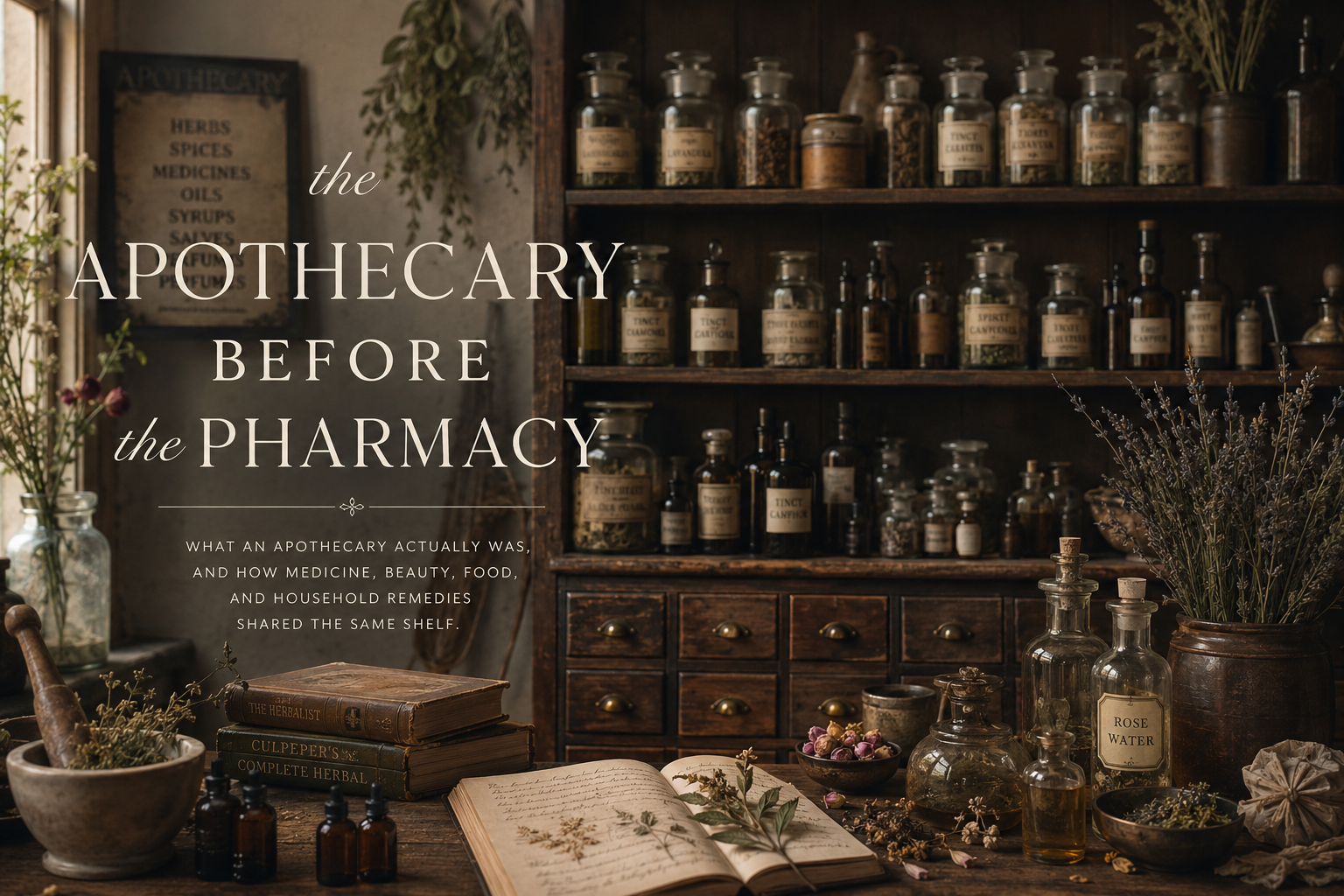
Before medicine came beneath fluorescent lights, behind white counters, sealed into little bottles and printed boxes, there was the apothecary.
I like to imagine what it would have felt like to walk into one.
Shelves crowded with jars. Drawers filled with dried materials. Bundles and bottles, oils and resins, spices brought from places you may never see yourself. The smell of herbs mingling with something sweet, something bitter, something unfamiliar.
Perhaps one person entered looking for something medicinal.
Another needed a spice.
Another wanted an aromatic preparation or perfume.
And somehow, all of these things belonged beneath the same roof.
That is the part of the apothecary that fascinates me most.
Because before we divided everything into neat little categories—medicine over here, cosmetics over there, food in another shop entirely—the lines between them could be surprisingly thin.
So, What Actually Was an Apothecary?
The apothecary wasn’t simply the mysterious herb-covered figure that modern imagination sometimes makes him—or her—out to be.
And no, “apothecary” was not another word for witch.
The history is much more interesting than that.
The word comes from the Latin apotheca, meaning a storehouse. In medieval England, apothecaries developed alongside merchants who dealt in valuable imported goods such as spices and herbs.
In London, their history can be traced through the medieval Guild of Pepperers and later the Grocers’ Company. Over time, some became increasingly specialized in preparing and dispensing medicinal substances.
By the middle of the sixteenth century, London’s apothecaries were functioning rather like the community pharmacists we would recognize today.
Their shops weren’t places of magic.
They were places of trade, knowledge, preparation, measurement, and medicine.
But Their Shelves Held More Than Medicine
This is where the history becomes particularly beautiful to me.
Earlier apothecary shops could sell an extraordinary mixture of goods: spices, herbs, drugs, confectionery, perfumes, and spiced wines.
Read that list again.
Medicine.
Perfume.
Food.
All passing across the same counter.
It makes perfect sense when you remember that many of the materials themselves didn’t belong exclusively to one category.
A rose did not know whether we intended to call it skincare, fragrance, food, or medicine.
Neither did rosemary.
Neither did honey.
Neither did oil.
Neither did a spice carried hundreds of miles across the world.
Those categories belonged to us.
The plant simply remained the plant.
What changed was how people prepared it and what they believed it could do.
The Medicine Chest, Pantry, and Dressing Table
Today, we tend to think of these as entirely separate worlds.
A bottle belongs in the bathroom.
A spice belongs in the kitchen.
Medicine belongs in the cabinet.
Perfume belongs on the dressing table.
But historically, ingredients could travel freely between these spaces.
Aromatic plants might scent a preparation.
Spices might flavor food and appear in medicinal compounds.
Oils and fats could become the foundations of ointments and preparations for the skin.
Flowers could find their way into waters, syrups, perfumes, foods, and remedies.
Honey could sweeten something meant for pleasure while also helping make a medicinal preparation more palatable.
There wasn’t always a bright line announcing:
THIS IS BEAUTY.
THIS IS FOOD.
THIS IS MEDICINE.
Sometimes the same cupboard supplied all three.
And perhaps that is why the old apothecary feels so familiar to those of us who still work closely with plants.
It Wasn’t All Gentle Herbs and Rose Petals
There is another side of this history that deserves to be remembered.
Old does not automatically mean safe.
Natural does not automatically mean harmless.
Historical medicine contained brilliant observations, accumulated plant knowledge, and practices that eventually contributed to modern pharmacy—but it also contained substances and treatments we now know could be ineffective, dangerous, or outright poisonous.
The people of the past worked with the knowledge available to them.
We have the privilege of having more.
I don’t believe honoring old knowledge requires pretending everything our ancestors did was better.
I think it means being curious enough to ask what they knew, humble enough to recognize what they didn’t, and wise enough to carry forward only what deserves carrying.
When the Apothecary Became Something More
The profession continued to change.
In London, apothecaries formally separated from the Grocers’ Company when James I granted them their own royal charter in 1617.
And something interesting happened after that.
People didn’t only come to apothecaries to have medicines prepared. Apothecaries increasingly gave medical advice themselves.
Physicians could be expensive and relatively scarce. Apothecaries were often much more accessible.
That created quite a fight over who was allowed to practice medicine.
Eventually, a famous legal decision in 1704—the Rose Case—confirmed the right of apothecaries in England to prescribe as well as dispense medicines.
The person behind the counter was slowly becoming something closer to the family doctor.
By the nineteenth century, the paths were separating again. Apothecaries increasingly evolved toward general medical practice, while chemists and druggists helped shape the profession we now recognize as pharmacy.
The old apothecary had not disappeared so much as divided into descendants.
The doctor.
The pharmacist.
The chemist.
The modern medicine cabinet.
Pieces of that old shop still surround us.
We simply stopped calling them by the same name.
What I Want to Bring Back
When I say that Wilding Hallow is inspired by the apothecary, I don’t mean that I want to abandon modern knowledge and pretend we are living five hundred years ago.
And I certainly don’t mean witchcraft.
I mean something much simpler.
I want to bring back the intimacy of knowing what is in the little bottle sitting on your dressing table.
I want plants to feel like plants again.
I want oils, flowers, waxes, herbs, and resins to be more than words buried halfway down an ingredient list.
I want to remember that beauty did not begin in a laboratory or beneath fluorescent store lights.
Women cared for their skin before there were beauty aisles.
People made perfume before there were department-store counters.
Families tended gardens, dried plants, infused oils, simmered preparations, and passed knowledge from one pair of hands to another long before any of us were here.
Not everything from the past needs resurrecting.
But perhaps some things are worth remembering.
The patience.
The simplicity.
The knowledge of materials.
The understanding that the things growing from the earth could have many lives—a flower might become fragrance, food, a preparation for the skin, or simply something beautiful sitting in a cup beside the window.
That is the apothecary I am interested in.
Not the fantasy of bubbling cauldrons and spells.
The real one.
A shopkeeper standing behind a counter surrounded by jars, measuring and grinding and mixing.
The strange little ancestor of the pharmacy, the doctor’s office, the beauty counter, and even parts of our pantry.
Maybe we’ve become so accustomed to separating those worlds that we’ve forgotten they once stood together.
I think that’s the piece I want to remember.
Before there was a pharmacy, there was a shelf full of jars—and someone who knew what was inside them.